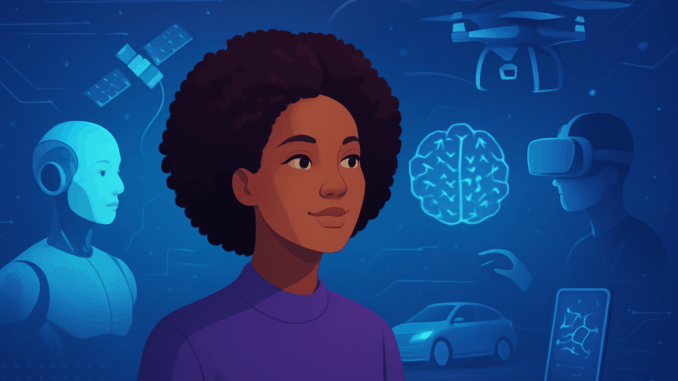
Technology is advancing faster than at any point in human history. What once seemed like science fiction has become part of everyday life, and by 2025, the world is experiencing a new wave of innovation across industries. These emerging technologies are not only transforming business operations but also reshaping how people work, learn, travel, and connect. From artificial intelligence to biotechnology and quantum computing, the technological landscape of 2025 is full of breakthroughs that promise to redefine the future.
This article explores the top emerging technologies shaping the future in 2025, how they work, why they matter, and what impact they are expected to have on society and global industries.
1. Artificial Intelligence (AI) and Autonomous Systems
AI continues to be the driving force behind digital transformation. By 2025, its capabilities have grown far beyond simple automation. AI-powered systems can now analyze complex data in real-time, make predictions with higher accuracy, and perform tasks that once required human intuition.
Key Advancements in 2025
- Generative AI Models: Advanced models produce human-like text, images, videos, and even code, boosting creativity and productivity across industries.
- Autonomous Vehicles: Self-driving cars, drones, and delivery robots are becoming more reliable, supported by stronger regulations and improved safety protocols.
- AI in Healthcare: AI algorithms assist in diagnosing diseases, predicting treatment outcomes, and personalizing patient care.
Impact on Society
AI is making operations more efficient, reducing costs, and helping businesses make smarter decisions. It’s also reshaping job roles, creating new opportunities in data science, AI engineering, and human-AI collaboration fields.
2. Quantum Computing
Quantum computing is one of the most groundbreaking technologies emerging in 2025. Unlike classical computers that process data using bits (0 or 1), quantum computers use qubits, allowing them to perform exponentially more calculations simultaneously.
Why Quantum Computing Matters
- It accelerates complex simulations, such as drug discovery and climate modeling.
- It improves cybersecurity by enhancing encryption systems.
- It solves optimization challenges in logistics, finance, and supply chain management.
Industries Benefiting
- Pharmaceuticals: Discovering new drugs at a faster rate.
- Finance: Portfolio optimization and risk analysis.
- Energy: Improving grid management and renewable energy research.
Although quantum computing is still in its early stages, 2025 marks a significant year, with major companies investing heavily in quantum research, pushing the technology closer to real-world applications.
3. Extended Reality (XR): AR, VR, and Mixed Reality
Extended Reality (XR), which includes Augmented Reality (AR), Virtual Reality (VR), and Mixed Reality (MR), is transforming how people interact with digital content.
What’s New in 2025?
- VR Workspaces: Businesses adopt immersive virtual offices where teams collaborate in 3D environments.
- AR Shopping Experiences: Retailers use AR to let customers virtually try products before buying.
- Mixed Reality in Education: Students can explore historical events, scientific concepts, and virtual laboratories in MR-enhanced learning spaces.
Growing Applications
- Gaming and entertainment
- Training and simulations
- Real estate and product visualization
- Healthcare therapy and surgical training
By 2025, XR technology is more accessible and realistic than ever, driven by lightweight headsets and improved motion-tracking systems.
4. Advanced Robotics and Human-Robot Collaboration
Robots have moved far beyond assembly lines. In 2025, advanced robotics combine machine learning, precision engineering, and autonomous decision-making to create multi-purpose systems that can perform complex tasks.
Key Developments
- Collaborative Robots (Cobots): Robots that safely work alongside humans in manufacturing, medical, and service industries.
- Household Robots: Smart robots that handle cleaning, cooking assistance, and home maintenance tasks.
- Medical and Surgical Robots: Improved precision tools that assist surgeons with minimally invasive procedures.
Impact on Businesses
Robotics reduces human error, increases efficiency, and lowers operational costs. Industries like manufacturing, agriculture, logistics, and hospitality are heavily investing in robotic solutions to meet labor shortages and improve productivity.
5. 6G Networks and Ultra-Fast Connectivity
The global rollout of 5G is still in progress, but research and early deployment of 6G technology are gaining momentum in 2025.
What Makes 6G Different?
- Speeds up to 100 times faster than 5G.
- Near-zero latency for real-time applications.
- Enhanced support for AI, IoT, and smart devices.
6G will enable innovations such as:
- Fully autonomous transportation systems
- Holographic communication
- Smart cities with real-time monitoring
- Remote robotic surgery with instant feedback
Why It Matters
With digital activities increasing every year, faster and more reliable connectivity is essential for powering the modern world.
6. Internet of Things (IoT) and Smart Ecosystems
The Internet of Things continues to expand in 2025 as billions of devices become interconnected across homes, workplaces, cities, and industries.
Emerging Trends
- Smart Homes: Connected appliances, AI-powered energy management, and enhanced home security systems.
- Smart Cities: Real-time monitoring of traffic, pollution, and public safety.
- Industrial IoT: Automated factories that track equipment health and optimize production in real-time.
Benefits of IoT
- Improved efficiency and productivity
- Better resource management
- Enhanced user experience through personalization
IoT is becoming the backbone of modern digital infrastructure.
7. Green Technology and Renewable Innovations
As the world focuses on sustainability, green technology is becoming a top priority in 2025. Advancements aim to reduce carbon emissions, increase energy efficiency, and create cleaner alternatives to traditional processes.
Notable Innovations
- Next-Generation Solar Panels: More efficient and flexible photovoltaic materials.
- Green Hydrogen: A clean alternative fuel for industries and transportation.
- Carbon Capture Technology: Systems designed to remove CO₂ from the atmosphere.
Sustainability in Tech
Companies across industries are adopting eco-friendly practices, such as carbon-neutral cloud computing and energy-efficient data centers.
8. Biotechnology and Personalized Medicine
Biotechnology is revolutionizing healthcare in 2025 with advanced genetic engineering, improved diagnostic tools, and personalized treatment plans.
Breakthroughs Shaping the Future
- Gene Editing (CRISPR): Targeted treatments for genetic disorders.
- Personalized Medicine: Treatments based on individual genetic profiles.
- Wearable Health Tech: Devices that monitor vital signs and predict health issues in real-time.
Impact
These advancements are making healthcare more proactive rather than reactive, helping individuals maintain better long-term health.
9. Blockchain Beyond Cryptocurrency
Blockchain is evolving beyond its association with digital currencies. In 2025, organizations are using blockchain technology to improve transparency, security, and efficiency across various sectors.
Key Applications
- Supply Chain Tracking: Ensuring product authenticity and traceability.
- Digital Identity Verification: Secure identity systems for banking and online services.
- Smart Contracts: Self-executing agreements used in legal, financial, and corporate processes.
Blockchain’s decentralized structure makes systems more secure and resistant to fraud, making it valuable for industries like finance, healthcare, and logistics.
10. Edge Computing and Real-Time Processing
Edge computing has become essential as more devices connect to the internet. Instead of sending data to distant cloud servers, edge computing processes information locally, reducing latency and bandwidth usage.
Why It Matters in 2025
- Enables real-time decision-making for autonomous vehicles.
- Supports smart manufacturing through instant machine data analysis.
- Improves speed and privacy for IoT devices.
Edge computing works hand-in-hand with AI and 5G/6G networks to support modern digital infrastructures.
Conclusion
The top emerging technologies of 2025 are transforming every aspect of life—from how we work and communicate to how we treat illnesses and protect the environment. AI, quantum computing, XR, robotics, IoT, biotechnology, and green innovations are unlocking new possibilities that will shape the next decade and beyond.
As these technologies continue to evolve, they will create new job opportunities, solve global challenges, and open the door to smarter, safer, and more connected societies. Staying informed and adaptable will be essential for individuals and businesses hoping to thrive in this rapidly changing technological era.